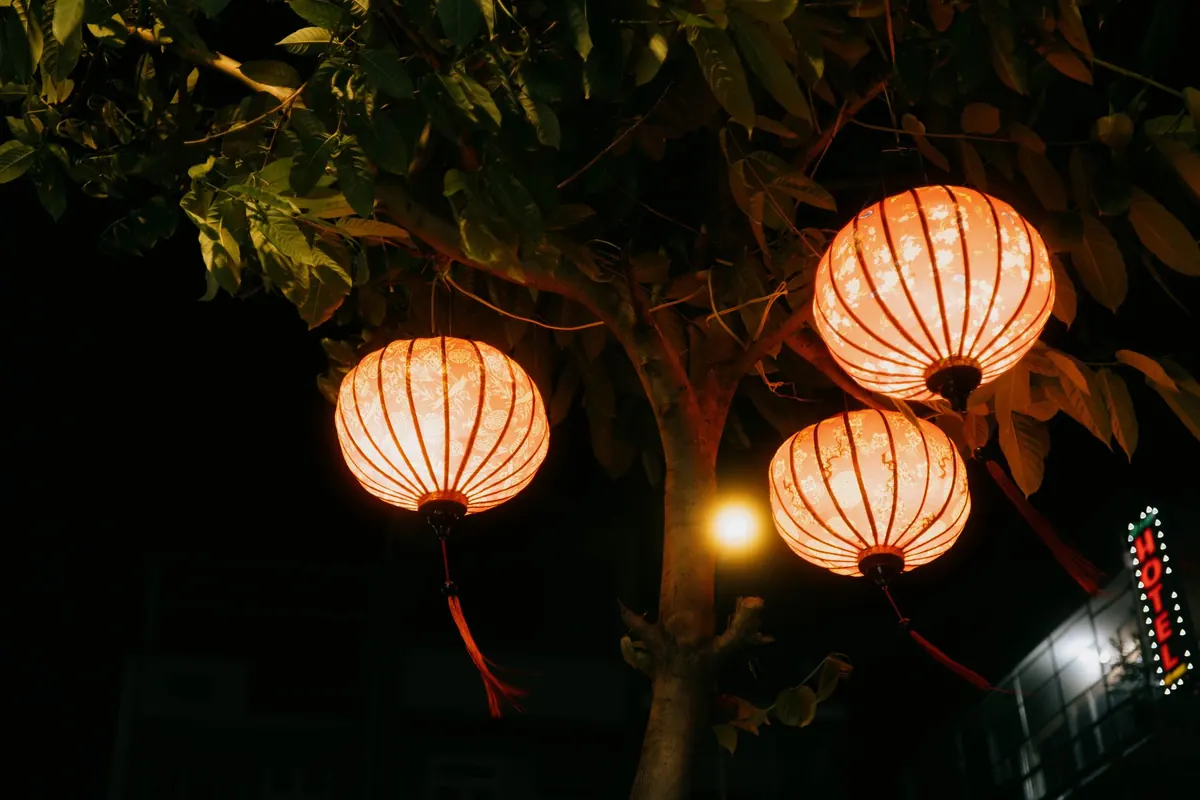
Trees give lanterns a setting that posts and brackets cannot match. A warm globe tucked into a maple, or five spaced along an oak limb above a path, changes the mood of a yard after dark. But a tree is not a pergola. Branches move, bark is living tissue, and a lantern that hangs perfectly still on a July evening can become a swinging weight when October wind arrives. Three decisions make the difference: how far the lantern sits from the wood, what holds it up, and how much freedom it has to swing. Get those right and a lantern can hang for a whole season without leaving a mark.
How Far to Hang a Lantern Below a Branch
Start with the drop. Leave at least 12 inches of cord between the underside of the branch and the top of the lantern. Any less and the lantern body chafes against bark in every gust; the paint wears, the branch wears, and the knot works loose. If you use a chain or a glass lantern with a metal cage, give it 15 to 18 inches so the top does not knock on the limb.
Then think about heads. Any lantern over a walkway, patio edge, or driveway should keep its lowest point at least 7 feet off the ground, and 8 feet where vehicles pass. A lantern hanging over a planting bed or a lawn corner can sit lower, around 6 feet, since nobody is walking under it. The cord matters too, even when the lantern itself is high enough.
Keep the drop short in wind. A long pendulum swings slower and wider than a short one, so the 12-inch minimum is a floor, not a target. If the lantern hangs so low that it threatens the heads of taller guests, move it sideways to a spot with better clearance rather than dropping it further.
Finally, distance from the trunk. Hang lanterns 2 to 3 feet out from the trunk on a limb that extends at least 4 feet. That gap is what keeps a gust from slapping the lantern into the trunk or into a low crotch, and it is the single most common mistake people make with big glass lanterns.
Choosing the Right Branch
Live wood only. Dead branches can hold for years and then let go on the night you have guests over. Tap the limb with your knuckles: dead wood sounds hollow and flat, live wood sounds solid. Skip anything with cracks, splits at the crotch, or mushrooms growing on the bark.
Thickness matters more than length. As a working rule, choose a branch at least as thick as your wrist for a lantern weighing a couple of pounds, and go thicker if you are hanging anything heavier or if the lantern catches wind. A wide-angled branch is stronger than one growing steeply upward against the trunk, where bark gets pinched between the two.
Position the strap about a third of the way out from the trunk along the limb. Near the trunk the wood is strongest but the lantern crowds the center of the tree; out at the tip the branch whips and dips. A third of the way out balances both.
Test before you commit. Tie a bag of sand or a bucket of similar weight to the spot you have chosen and leave it for a day. Watch it in wind, look for bending, and check the crotch for fresh cracking. Moving the strap two feet is much easier than repairing a limb.
Straps, Ropes, and What Protects Bark
Anything wrapped around a branch should spread its load over as much bark as possible. Thin cord concentrates force into a narrow band, and bark does not recover from that quickly.
- Use flat webbing straps at least 1 inch wide, ideally 1.5 to 2 inches, in nylon or polyester. Wrap twice around the branch so the pressure doubles up along different bark.
- Pad thin-barked trees. Birch, beech, young maples, and Japanese maples bruise easily. Slip a strip of felt, burlap, or a rubber pad under the strap.
- Rope only as a temporary. Soft braided nylon or polyester, a quarter inch or thicker, is fine for a season. Thin, stiff, or abrasive rope cuts into bark.
- Skip wire, chain, zip ties, and anything screwed in. Never drive nails or eye hooks into a trunk or limb. Trees do not heal around metal; they wall it off and carry the wound for life.
- Recheck as the tree grows. A strap that fit in spring can tighten by midsummer. Loosen and reposition once a season, and take hardware down for winter if you live where ice loads branches.
If you want something permanent, hang it from a post or a wall bracket near the tree rather than from the tree itself. A clean strap left up for months is a gamble; a strap left up for years is a problem.
Hardware That Holds in Gusts
Every lantern hangs from a chain of parts, and the weakest one sets the limit. Build the load path deliberately: branch strap, then a metal ring or dee, then a swivel snap or quick link, then the lantern's own ring. Stainless steel or marine brass survives weather; cheap zinc-plated hardware rusts, seizes, and eventually snaps.
Use quick links with threaded collars rather than open hooks, which can jump free when a lantern twists. A swivel between the strap and the lantern stops the cord from winding itself tight in a breeze, which is how many lanterns end up lower than planned.
Keep the lanterns themselves light. A solar or LED fixture with a shatter-resistant globe is a better tree occupant than a heavy hurricane lantern with real glass. Heavy glass high in a swaying tree is a falling object waiting for the right gust. And check the small loop on top of the lantern, since that is often thinner than the hardware you just bought.
Keeping Lanterns From Swinging Into the Trunk
You cannot stop a branch from moving, but you can control how the lantern responds.
- Shorten the drop. Less length, less arc. This is the fastest fix.
- Add a second line. Run a soft cord from the lantern's top ring to a branch above and to one side. Two lines at an angle hold the lantern far steadier than one vertical cord.
- Go to three points when it is exposed. A ring with lines to three branches spreads the load and kills most of the swing in an open yard.
- Angle the main line toward the trunk. A lantern hung on a limb will drift downhill toward the trunk in wind. If the line runs slightly away from the trunk, that drift works against the swing instead of into it.
- Hang on the sheltered side. Watch which way gusts usually come through your yard and place lanterns on the opposite side of the trunk where possible.
Guy lines that reach down to a stake keep a lantern very still, but they cross walkways at throat height. Keep any low line marked or take it down when guests arrive.
Wind Safety and Seasonal Checks
Lanterns are inexpensive enough to bring in. When strong wind is forecast, take them down or at least lower them and shorten the lines. If ice or heavy wet snow is coming, take them down earlier; a lantern with a frozen cord will not swing, it will hang hard and load the branch.
Do a quick inspection loop before each season: look for frayed webbing, rusted collars, cracked globes, sagging cord, and bark that has turned dark or slick under a strap. Check outdoor cords too, and plug them into a GFCI outlet with a drip loop so water runs off instead of into the connection. Keep cords out of reach of mowers, pets, and bare feet.
One safety note worth repeating: do not climb the tree, and do not lean a ladder into a limb you are about to load. Most strap work can be done from the ground with an extension pole and a hook. If a lantern must go high, or if branches are anywhere near power lines, hire a professional arborist rather than working around the wires yourself.
A Simple Order to Work In
Pick the lantern, weigh it in your hand, and choose a branch that is clearly thicker than the strap needs. Set the strap a third of the way out from the trunk, pad it if the bark is thin, and hang the lantern with a 12-inch drop. Step back and look at it from the angle your guests will see. If it hangs within 2 feet of the trunk, move it. If it can reach a path at head height, raise it.
Then wait for a windy night, watch it move, and adjust one thing at a time: shorten the drop, add a second line, or move it to a calmer branch. Lanterns in trees reward patience. A little planning in daylight means warm light in the branches all season, and a tree that looks exactly the way you found it.
Photo: FOX ^.ᆽ.^= ∫ / Pexels